
Mild Steel vs Aluminum vs Corten for Decorative Laser Cut Panels
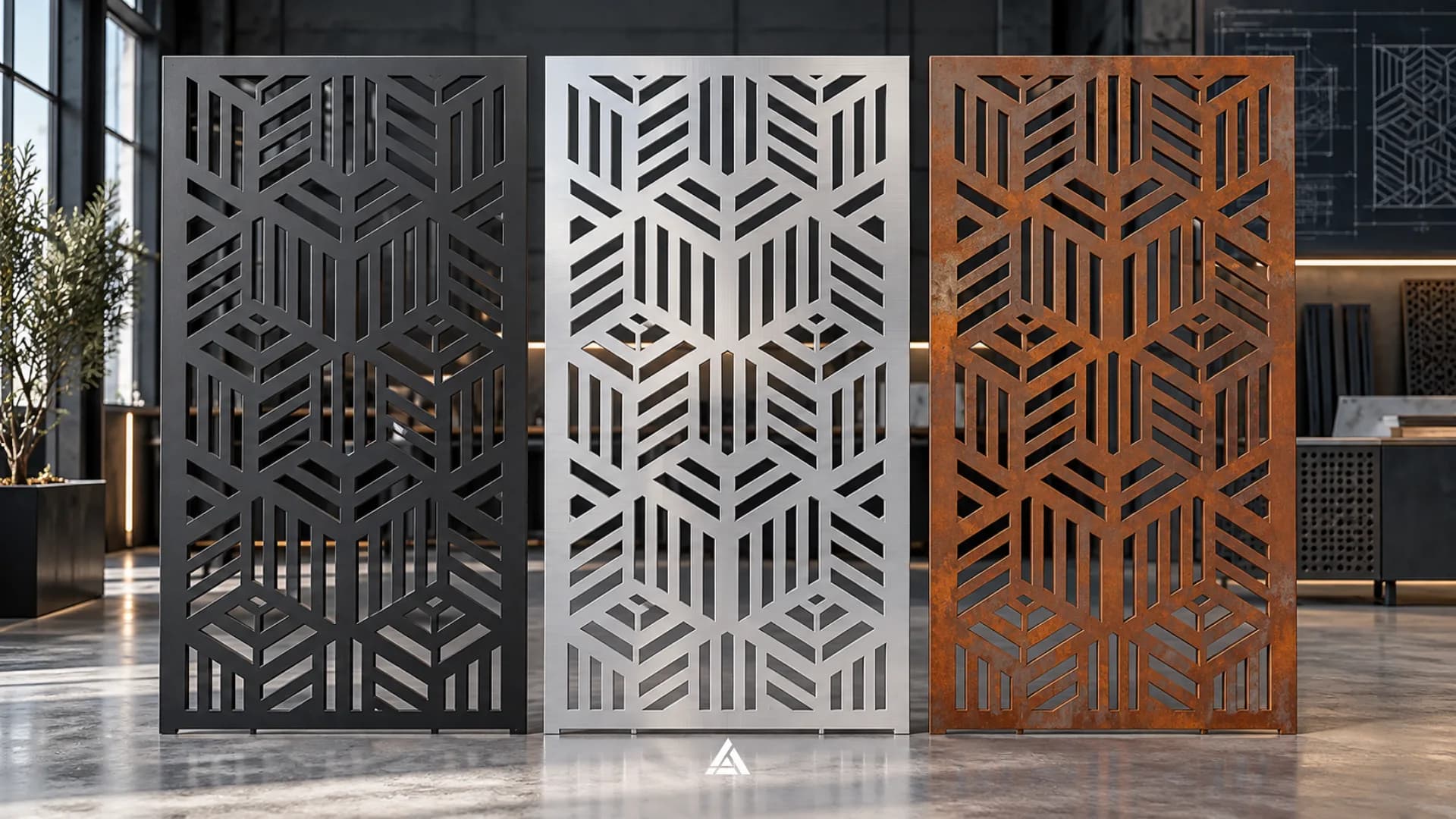
A decorative DXF can look perfect on screen. Cut that same design from three different metals, however, and it becomes three very different products: a rigid gate insert, a lightweight privacy screen or an architectural panel that develops a natural patina over time.
The geometry is only half of the design. The material completes it.
When comparing steel vs aluminum vs Corten panels, the best choice depends on what matters most for the finished project: strength, weight, maintenance, appearance or cost.
Three Materials, Three Different Results
| Material | Best quality | Main consideration | Ideal for |
|---|---|---|---|
| Mild steel | Strength and value | Requires outdoor protection | Gates, fences and framed panels |
| Aluminum | Low weight and corrosion resistance | May require more thickness or support | Privacy screens, lightweight gates and façades |
| Corten / weathering steel | Natural architectural patina | Exposure and drainage must be planned | Garden panels, signs and landscape features |
Mild Steel: The Reliable Workhorse
Mild steel remains one of the most practical materials for decorative laser-cut panels. It is strong, widely available and generally economical to fabricate. For gates, fence inserts and large framed screens, that combination is difficult to ignore.
Its rigidity allows a well-supported panel to hold its shape without adding unnecessary complexity to the structure. Mild steel is also familiar to most metal workshops, making welding, framing and installation straightforward.
The trade-off is corrosion protection. A panel installed outdoors normally needs powder coating, galvanizing or a suitable exterior paint system. Cut edges, welds and fixing points must be prepared properly because the protection is only as effective as its weakest area.
Choose mild steel when: strength, availability and cost are the priorities, and the additional weight can be supported safely.
Aluminum: When Every Kilogram Matters
Aluminum changes the handling and installation of a project. Its lower weight makes it especially useful for movable gates, balcony screens, façade elements and larger panels that should place less load on frames, hinges or walls.
It also offers good corrosion resistance and can be powder coated, anodized or finished to suit a contemporary architectural style.
Lightweight does not mean that thickness can be ignored. Aluminum is less rigid than steel at the same thickness, so a large panel—or a pattern with generous open areas—may need thicker material, a perimeter frame or additional fixing points.
The alloy and cutting setup matter as well. Laser parameters should be selected specifically for the chosen aluminum grade and thickness rather than copied from a steel job.
Choose aluminum when: low weight, clean finishing and outdoor durability are more important than achieving the lowest initial material cost.
Corten: A Surface Designed to Evolve
Weathering steel, commonly referred to as Corten, is selected as much for its character as for its performance. When exposed to alternating wet and dry conditions, it develops a protective rust-like patina that gradually moves from orange tones toward deeper brown shades.
This evolving surface gives garden panels, signs, façades and landscape features a distinctive architectural finish without relying on conventional paint.
But the patina should be designed into the project—not treated as an afterthought. The panel needs exposure to the right conditions, along with drainage that prevents water from remaining trapped. During the early weathering stage, runoff may also stain nearby concrete, stone or paving.
The actual weathering-steel grade and installation environment should therefore be confirmed before production.
Choose weathering steel when: the natural patina is a central part of the visual concept and the installation allows proper drainage and wet-and-dry exposure.
Can the Same DXF Be Used for All Three?
Often, yes—but not without checking it first.
A pattern that performs well in mild steel may feel less rigid in aluminum at the same thickness. A design intended for Corten may need more attention around drainage points, borders and areas where moisture could collect.
Before sending the file to production, review:
- The narrowest bridges connecting the pattern.
- The smallest openings and internal details.
- The percentage of material removed by the design.
- The panel dimensions and unsupported area.
- The frame, hinges, anchors and mounting holes.
- Kerf, heat input and the fabricator’s minimum feature size.
- The final coating, anodized finish or natural patina.
Material thickness and DXF geometry must be considered together. Start with our guide to metal thickness for laser-cut decorative panels, then verify the final specification with your fabricator.
The Decision in 30 Seconds
Choose mild steel for dependable strength and cost-effective fabrication.
Choose aluminum for lower weight, corrosion resistance and easier installation.
Choose Corten or weathering steel for a premium outdoor surface that develops character over time.
There is no universal winner. The right material is the one that supports the design, installation and environment as one complete system.
Before full production, complete a test cut and confirm the material grade, thickness, cutting parameters and finishing process.
Ready to select a pattern? Explore the AlbCo Partners 12,000+ DXF design collection for gates, fences, privacy screens, room dividers and decorative metal panels.