
Powder Coating, Paint or Patina? Finishes for Laser Cut Metal Panels
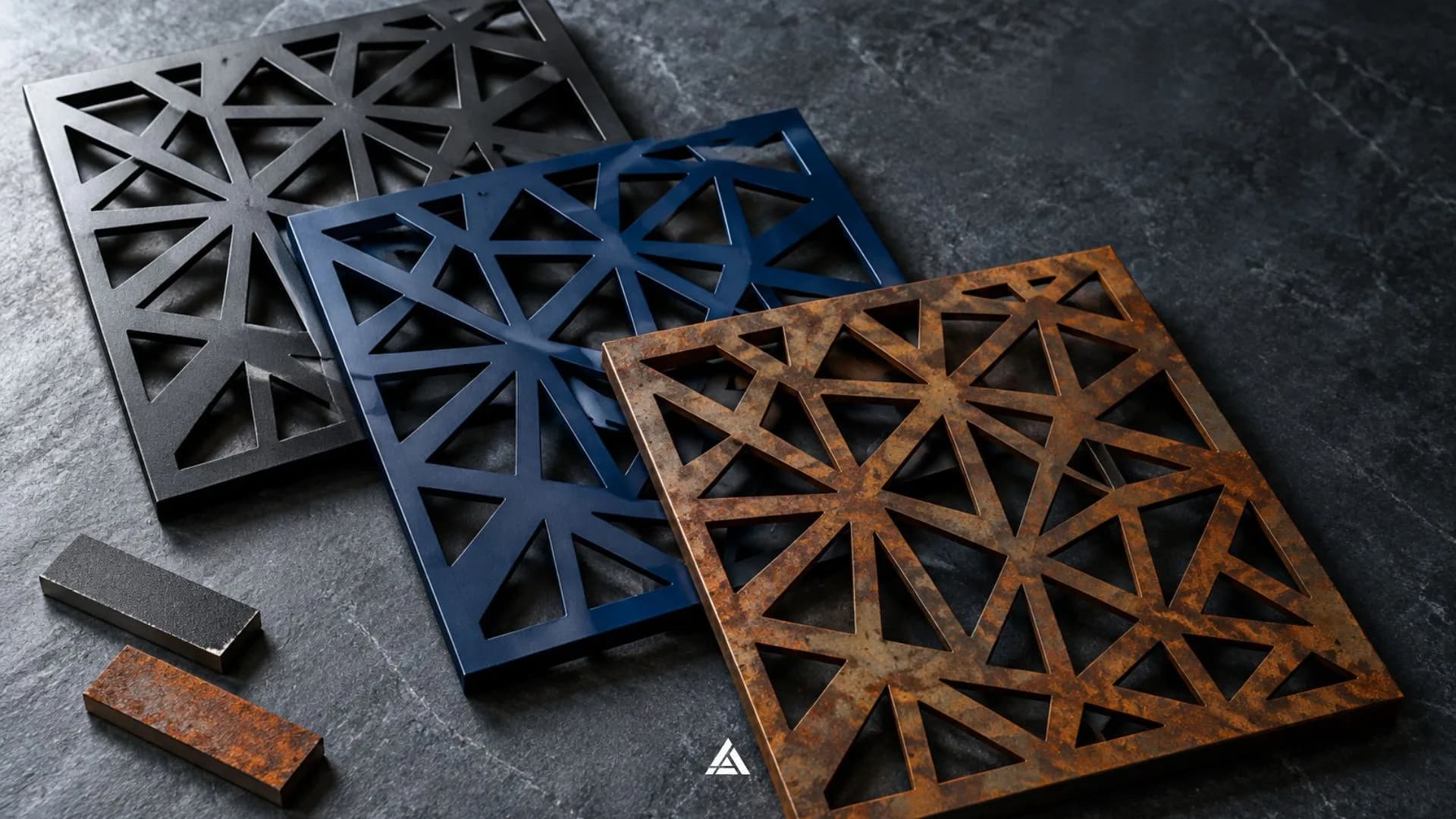
Powder Coating, Paint or Patina? Finishes for Laser Cut Metal Panels
The finish applied to a laser cut metal panel affects more than its appearance. It can influence corrosion resistance, maintenance, colour consistency and how well the panel performs outdoors.
Powder coating, liquid paint and patina can all produce professional results, but they serve different project requirements. The right choice depends on the metal, installation environment, production volume and desired visual effect.
The Quick Decision
Choose powder coating for a consistent, durable finish with a wide selection of colours and textures.
Choose liquid paint when flexibility, easier repairs or on-site application are important.
Choose patina when the changing surface of weathering steel is part of the architectural design.
No finish can compensate for unsuitable material, poor preparation or a panel that traps water around its edges and mounting points.
Powder Coating: Durable and Consistent
Powder coating uses electrically charged dry powder that is applied to the metal and cured with heat. The process creates an even protective layer and is commonly used on gates, fences, privacy screens and architectural panels.
It is a strong option when several panels need the same colour and surface texture. Matte black, bronze, grey and fine-textured finishes are especially popular for decorative metalwork.
The main advantages include:
Consistent colour across multiple panels.
Good resistance to wear and weather exposure.
A wide selection of colours, gloss levels and textures.
A clean finish around detailed laser-cut patterns.
Surface preparation remains essential. Oil, scale, rust and cutting residue must be removed before coating. Exterior projects also require a powder system intended for outdoor and ultraviolet exposure.
Powder coating may be less practical for panels that exceed the coating oven’s capacity or projects that require frequent on-site repairs.
Liquid Paint: Flexible and Repairable
Liquid paint is suitable for custom work, small production runs and panels that cannot easily be placed in a curing oven. It also allows damaged areas to be repaired more easily after installation.
For mild steel, a complete system normally includes surface preparation, a compatible primer and one or more topcoats. Applying colour directly over untreated steel may create a good initial appearance but weak long-term protection.
Paint offers:
Flexible colour matching.
Easier on-site application.
Simpler touch-ups after installation.
Practical finishing for unusually large panels.
Its performance depends heavily on preparation, application conditions and the selected coating system. Runs, uneven coverage and premature peeling are more likely when the surface has not been prepared correctly.
Patina: A Finish That Changes Over Time
Patina is selected when natural variation is part of the intended result. Weathering steel develops a rust-coloured protective surface under suitable cycles of wetting and drying.
This finish is often used for garden panels, landscape features, facades and architectural screens. Every panel develops slightly differently, creating a surface that changes with time rather than remaining completely uniform.
However, patina requires careful planning. Early weathering can create runoff that stains nearby stone, concrete or paving. Continuously damp environments and areas with high salt exposure may prevent the surface from stabilising correctly.
Ordinary mild steel rust should not automatically be treated as equivalent to a stable weathering-steel patina. If this appearance is required, confirm the material specification and finishing process with the fabricator.
Read our mild steel vs aluminum vs Corten comparison before selecting the base metal.
Which Finish Should You Choose?
Project requirement
Recommended starting point
Exterior gates and privacy screens
Exterior-grade powder coating
Small custom or one-off projects
Liquid paint
Easy future repairs
Liquid paint
Consistent batch production
Powder coating
Natural architectural appearance
Weathering-steel patina
Indoor decorative panels
Paint or powder coating
These are starting points. Exposure, maintenance expectations and the selected metal should always be reviewed before production.
Design the Panel With the Finish in Mind
Finishing decisions should begin before cutting. Narrow gaps, enclosed corners and poorly positioned mounting holes can make preparation and coating more difficult.
The design should allow drainage, avoid unnecessary moisture traps and provide enough strength around fixing points. Panel thickness must also suit the final dimensions and installation method. Review our metal thickness guide before fabrication.
Before approving the finish, confirm:
The correct base metal and thickness.
Interior or exterior exposure.
Required colour, texture and gloss.
Surface preparation and primer requirements.
Areas that must remain uncoated.
Drainage, mounting and edge protection.
A finish sample when colour accuracy is important.
Final Recommendation
Powder coating is often the strongest general choice for professional decorative panels that need a consistent and durable appearance. Liquid paint provides more flexibility and easier repairs, while patina works best when natural ageing is an intentional part of the design.
The finish protects the surface, but the result still begins with accurate geometry and a pattern suited to fabrication.
Explore the AlbCo Partners collection of 12,000+ DXF designs for gates, privacy screens, fences, room dividers and decorative metal panels.